Part 3 of a three-part series on auditing before automating.
- Audit Before You Automate: The AI GTM Trap
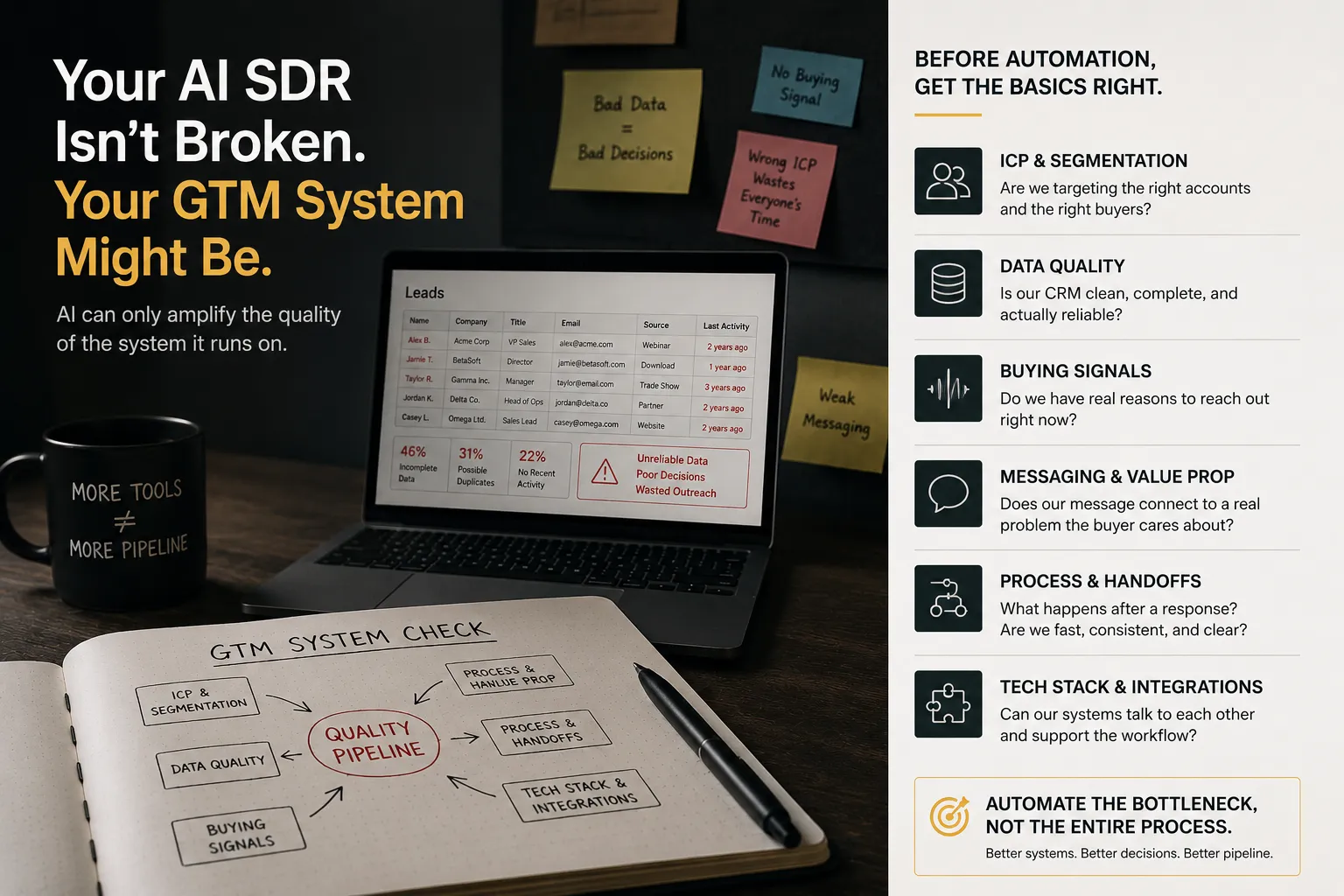
- Your AI SDR Isn’t Broken. Your GTM System Might Be.
- The HOLD Principle: Why the Best AI SDR Sometimes Does Nothing - you are here
Almost every outbound system in the market shares one assumption: that the correct output is a message.
Give it an account and it will produce something, because that is what it is for. But a system that must always produce a message will produce one whether or not there is anything worth saying, and at machine speed that is how outbound stops being worth reading.
The more valuable behaviour is the opposite: a system that can look at an account and decide, with reasons, that the right action is no action.
This follows the AI GTM trap and what an audit should examine.
The most valuable AI decision might be “HOLD”
Suppose an account matches your ICP.
It has 500 employees.
It uses the right technology.
The buyer has the right job title.
Perfect lead, right?
Not necessarily.
Maybe the company just signed a competitor.
Maybe they are in the middle of an acquisition.
Maybe the person changed roles two weeks ago.
Maybe there is no evidence of the problem you solve.
Maybe they have never shown any buying signal.
Maybe your own data is contradictory.
A conventional outbound system says:
Great. Send the email.
A better GTM system can say:
HOLD.
That is not failure.
That is intelligence.
The absence of a qualified reason to engage is itself useful information.
This is one of the ideas that makes Amoris different from the generic “send more personalized emails” approach.
The system should not merely answer:
“Can we contact this person?”
It should answer:
“Do we have enough evidence that contacting this person is worth spending our reputation, attention and sales capacity?”
If the answer is no, hold.
The outbound market is already telling us this
The GTM engineering community is full of people building increasingly sophisticated systems around Apollo, Clay, Instantly, n8n and similar tools.
One recent build described an end-to-end workflow that sources leads, enriches them, researches LinkedIn and company websites, identifies operational pain points, generates personalized emails and sends them automatically.
Another GTM consultant described a more diagnostic approach: auditing the existing lead generation engine, validating ICP and signals, and checking fundamentals such as email authentication before scaling outbound.
That contrast is important.
The market is not missing clever workflows.
The market is learning that clever workflows need a good reason to exist.
And founders are starting to feel the difference
The public conversation around AI SDRs is becoming more nuanced.
The Founders Report noted in 2026 that AI SDR technology had reached a point where it could credibly replace some early-stage outbound work, while enterprise buyers were simultaneously becoming harder to engage with through cold outreach.
That creates an interesting tension.
AI makes outbound cheaper.
But cheaper outbound does not automatically make buyers more receptive.
If anything, the opposite can happen.
When everyone can generate 100,000 personalized emails, personalization itself stops being a differentiator.
The scarce resource becomes relevance.
The next generation of GTM will be evidence-led
This is where the market is heading.
Not:
More leads.
Not:
More emails.
Not:
More AI agents.
But:
Better evidence about who to pursue, why now, what to say and when not to say anything.
That changes the job of an AI GTM agency.
The agency should not begin with a technology stack.
It should begin with a diagnosis.
Then the stack follows.
Maybe the answer is Clay.
Maybe it is n8n.
Maybe it is LangGraph.
Maybe it is a CRM rebuild.
Maybe it is better enrichment.
Maybe it is lead routing.
Maybe it is inbound qualification.
Maybe it is an AI SDR.
Maybe it is none of these.
That is the point.
AI should make GTM more intelligent, not merely more automated
The future of B2B GTM will absolutely include AI agents.
That part is not controversial anymore.
The question is what those agents will be allowed to do.
The immature version says:
“Let the AI do everything.”
The more mature version says:
“Give the AI the right context, the right tools, the right constraints and the right feedback loop. Then let it make the decisions it is actually qualified to make.”
Sometimes that decision will be:
SEND.
Sometimes:
QUALIFY.
Sometimes:
FOLLOW UP.
And sometimes:
HOLD.
That last decision may end up being one of the most valuable ones.
Because in a world where everyone can automate outreach, knowing when not to reach out becomes a competitive advantage.
So what should an AI GTM agency actually sell?
Not automation.
Not agents.
Not Clay workflows.
Not n8n workflows.
Those are implementation components.
The real offer should be:
We identify where your GTM system is losing revenue, determine what can actually be improved with AI and automation, and build the system around that finding.
For a company with a healthy GTM motion and a prospecting bottleneck, the result might become an AI SDR.
Its job could be straightforward:
Lead → Research → Qualify → Engage → Follow up → Book qualified meeting → Learn
But the sequence begins with the audit.
Because the goal is not to produce activity.
The goal is to produce qualified pipeline.
The Amoris approach
This is the philosophy behind Amoris.
We do not believe every GTM problem needs an AI agent.
We do not believe every company needs an AI SDR.
We do not believe more automation automatically means better GTM.
We start by looking at the system.
Where does the data come from?
Where does it break?
How are accounts selected?
What signals exist?
How are leads qualified?
What happens after a response?
Where does the human team spend time?
Which decisions are repetitive?
Which decisions require judgment?
Which workflows are ready to be automated?
And which ones should be left alone?
Only then do we build.
The resulting system can use tools such as Clay, n8n, LangGraph, CRM integrations, enrichment providers, LLMs and other infrastructure.
But the technology is downstream of the diagnosis.
That is deliberate.
Frequently Asked Questions
What does “HOLD” mean in AI GTM?
HOLD means the system deliberately does not initiate outreach when available evidence does not justify contacting an account or prospect. Instead of treating every qualified-looking contact as an opportunity for automation, an evidence-led system can pause until stronger signals or information are available.
How should companies measure AI GTM success?
Measure revenue outcomes rather than AI activity. Useful metrics include qualified meeting rate, lead-to-opportunity conversion, pipeline generated, opportunity conversion, revenue influenced, response quality and sales time recovered. HubSpot similarly recommends evaluating AI prospecting against response rates, meeting conversion, lead-to-opportunity conversion, pipeline velocity and revenue-related metrics.