Part 1 of a three-part series on auditing before automating.
- Audit Before You Automate: The AI GTM Trap - you are here
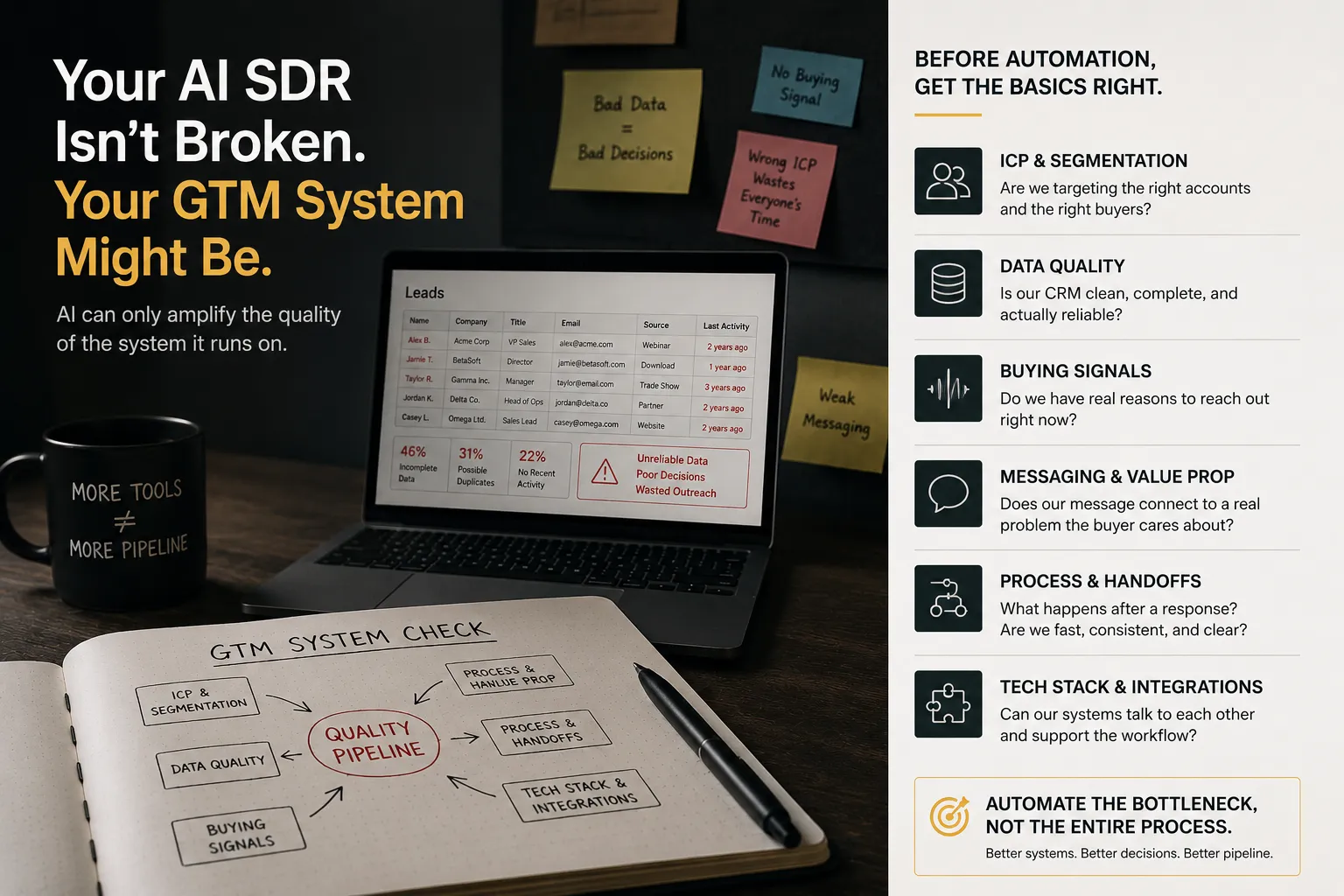
- Your AI SDR Isn’t Broken. Your GTM System Might Be.
- The HOLD Principle: Why the Best AI SDR Sometimes Does Nothing
There is no shortage of AI for sales anymore.
There are AI SDRs.
AI prospecting agents.
AI researchers.
AI personalization engines.
AI lead scorers.
AI outbound platforms.
AI GTM engineers.
AI agents that connect to your CRM, enrich a contact, research their company, write an email and send it before you have finished your morning coffee.
The technology is getting very good.
And yet a strange thing is happening.
A lot of companies are still not getting the revenue outcomes they expected.
That should make us uncomfortable.
Because if the problem were simply that sales teams needed more automation, the market should already be swimming in success stories.
Instead, we keep seeing companies add more tools, more workflows, more enrichment and more AI agents while the underlying GTM motion remains fundamentally unchanged.
It is like putting a Ferrari engine into a car with square wheels.
Technically impressive.
Still not going anywhere.
That is the problem Amoris was built around.
The real AI GTM problem is not a lack of automation
Most companies approaching AI in GTM start with a technology question:
“What can we automate?”
That sounds reasonable.
It is also often the wrong first question.
A better question is:
“Where is our GTM system actually breaking?”
Those are very different questions.
Imagine a B2B company has 10,000 leads sitting inside its CRM.
The obvious AI project is easy to imagine.
Enrich the leads.
Score them.
Research the companies.
Generate personalized emails.
Send sequences.
Book meetings.
Everyone goes home happy.
Except there is one inconvenient possibility.
Maybe the leads were never the problem.
Maybe the ICP is wrong.
Maybe the offer is weak.
Maybe the messaging is disconnected from the buyer’s actual problem.
Maybe the company is targeting people who cannot buy.
Maybe the CRM contains years of duplicate and outdated data.
Maybe sales follows up too slowly.
Maybe inbound leads are being routed badly.
Maybe the qualification criteria are inconsistent.
Maybe meetings are being booked with people who have no real buying intent.
Maybe the sales team is generating meetings but failing to convert them.
Maybe the company does not have enough proof to make cold outbound credible.
Maybe there is no meaningful signal telling you why someone should buy now.
And if any of those are true, adding an AI SDR does not fix the problem.
It simply allows you to run the wrong process faster.
The GTM automation paradox
The irony of AI GTM is that automation makes bad assumptions more dangerous.
Before AI, a bad sales process had a natural speed limit.
A human SDR could only research so many accounts.
They could only write so many emails.
They could only make so many calls.
They could only make so many mistakes.
AI removes those limits.
Now the same bad assumption can be propagated across thousands of accounts.
That is not a productivity gain.
That is error multiplication.
A recent discussion in the GTM engineering community described exactly this problem. An outbound agent connected to Salesforce, Apollo, Clay, Slack and an email platform began making confident decisions from conflicting data. Different systems had different versions of the same contact. Enrichment providers disagreed. The agent inherited the inconsistency and acted on it at scale.
The important lesson was not “the prompt needs improvement.”
The problem was upstream.
The system was being asked to reason over unreliable information.
That distinction matters enormously.
AI is only as good as the GTM system it enters
This is becoming increasingly obvious across the sales technology market.
Salesforce’s 2026 State of Sales research found that 46% of sales professionals using AI agents said data quality issues hurt their sales efforts. The report also identifies manual errors, duplicate data, incomplete data and security concerns among the major problems holding AI-enabled sales teams back.
Clay makes a similar point in its own GTM engineering framework.
Its model starts with three layers:
- Data foundation
- Data modeling
- Data activation
And the first layer is not glamorous.
It is CRM hygiene.
Clean records.
Deduplication.
Enrichment.
Ownership.
Reliable data.
Only after that foundation does the system move into identifying signals and activating them through revenue workflows.
That is a useful mental model for anyone evaluating an AI GTM agency.
Because the shiny part is usually the third layer.
The agent.
The workflow.
The outbound sequence.
The automated research.
But the boring layer underneath often determines whether any of it works.
This is where GTM engineering gets interesting
GTM engineering is a relatively new discipline, and the category itself is still being defined.
Clay describes a GTM engineer as someone who builds automated revenue systems using AI, data enrichment and workflow automation rather than operating GTM entirely by hand.
But practitioners are discovering an important problem.
The technical work is often easier than explaining what the work actually is.
One GTM engineering founder recently described the problem bluntly: companies often do not know whether to categorize a GTM engineer as RevOps, sales operations, a developer or something else. The actual work sits somewhere between those categories, stitching together CRM data, product data, intent signals and workflows into a functioning revenue system.
That ambiguity is understandable.
The category is new.
But it also creates a dangerous temptation.
When you have a new technical capability, you start looking for problems that justify using it.
That is backwards.
The “we have a hammer” problem
There is an old joke about consulting:
If all you have is a hammer, everything starts looking like a nail.
AI has given GTM teams a much larger toolbox.
Clay.
LangGraph.
n8n.
LLMs.
CRM APIs.
Intent data.
Enrichment waterfalls.
Web research.
Agent frameworks.
The problem is no longer a lack of tools.
The problem is deciding which tool belongs where.
A founder can now spend a weekend connecting Clay to an LLM and n8n and create something that looks remarkably impressive.
Research a company.
Find the decision maker.
Generate an email.
Send it.
Update the CRM.
Congratulations.
You have automated something.
But have you improved your GTM?
Those are not the same thing.
The Netflix problem
Think about Netflix.
Netflix does not need to recommend a movie to you simply because it can.
The value is in understanding what you are likely to want.
If the recommendation engine misunderstood you, giving it the ability to recommend 100 movies per second would not make Netflix better.
It would make the wrong recommendations faster.
GTM works the same way.
The goal is not to maximize:
AI-generated outreach.
The goal is to maximize:
qualified revenue conversations.
Everything in between is an implementation detail.
AI GTM should work like medicine, not like a tool catalog
If you walk into a good doctor’s office and say:
“I need an MRI.”
The doctor does not immediately hand you an MRI.
They ask why.
What happened?
Where does it hurt?
How long?
What changed?
What does the examination show?
Then they decide what test or treatment makes sense.
AI GTM needs the same discipline.
Diagnosis before intervention.
Otherwise you get the business equivalent of taking an MRI because you happen to own an MRI machine.
The uncomfortable truth about AI GTM
We are entering a period where building an impressive GTM automation system is becoming relatively easy.
Knowing what not to automate is becoming the harder skill.
Anyone can make an agent research a company.
The harder question is whether the company should have been researched in the first place.
Anyone can generate a personalized email.
The harder question is whether the prospect has given you a reason to send it.
Anyone can connect a CRM to an AI agent.
The harder question is whether the CRM contains enough truth for the agent to make a good decision.
Anyone can create a workflow.
The harder question is whether the workflow improves the revenue metric that actually matters.
That is the gap.
The new GTM question
The question businesses should be asking in 2026 is not:
“What AI GTM tool should we buy?”
It is:
“What is actually preventing our GTM system from producing more qualified pipeline?”
Then ask:
“Can AI fix it?”
Then:
“Is our data and technology stack ready for it?”
Then:
“What should we automate?”
And finally:
“How will we know it worked?”
That order matters.
Because AI is very good at scaling a system.
It is getting very good at reasoning inside a system.
But it still cannot rescue a company from a GTM problem that nobody bothered to diagnose.
Audit first. Automate second. Measure the outcome.
That is the difference between adding AI to GTM and actually engineering a better GTM system.
The bottom line
The future of GTM is not more automation for its own sake.
It is better decisions, made faster, with better evidence.
The winners will not necessarily be the companies with the most AI agents.
They will be the companies that know:
what to automate,
what not to automate,
when to act,
when to HOLD,
and how to prove the system created real pipeline.
That is where AI GTM gets interesting.
And that is where we believe the work should begin.
Audit first. Automate what deserves to be automated. Build for qualified pipeline.
Where this goes next
If the argument holds, the next question is practical: what exactly should an audit examine, and why does AI make weak inputs more dangerous rather than less? That is part two. The decision layer underneath it - when the right answer is to send nothing at all - is part three.
Frequently Asked Questions
What is an AI GTM agency?
An AI GTM agency designs and implements AI-powered systems that improve parts of a company’s go-to-market process. This can include prospect research, lead qualification, enrichment, outbound engagement, CRM workflows, lead routing and sales intelligence. The strongest implementations start with the company’s existing GTM process rather than assuming a particular AI solution is required.
What is GTM engineering?
GTM engineering is the practice of using data, automation, AI agents and software workflows to build and improve revenue processes. Modern GTM engineering commonly combines CRM data, enrichment, intent signals, AI research and automated activation. Clay describes the discipline as progressing from data foundation to data modeling and finally data activation.
Is AI GTM the same as automated cold email?
No. Cold email automation is one possible component of a GTM system. AI GTM can also involve account research, lead qualification, signal detection, inbound routing, CRM intelligence, sales enablement, follow-up, pipeline management and other revenue workflows.