Part 2 of a three-part series on auditing before automating.
- Audit Before You Automate: The AI GTM Trap
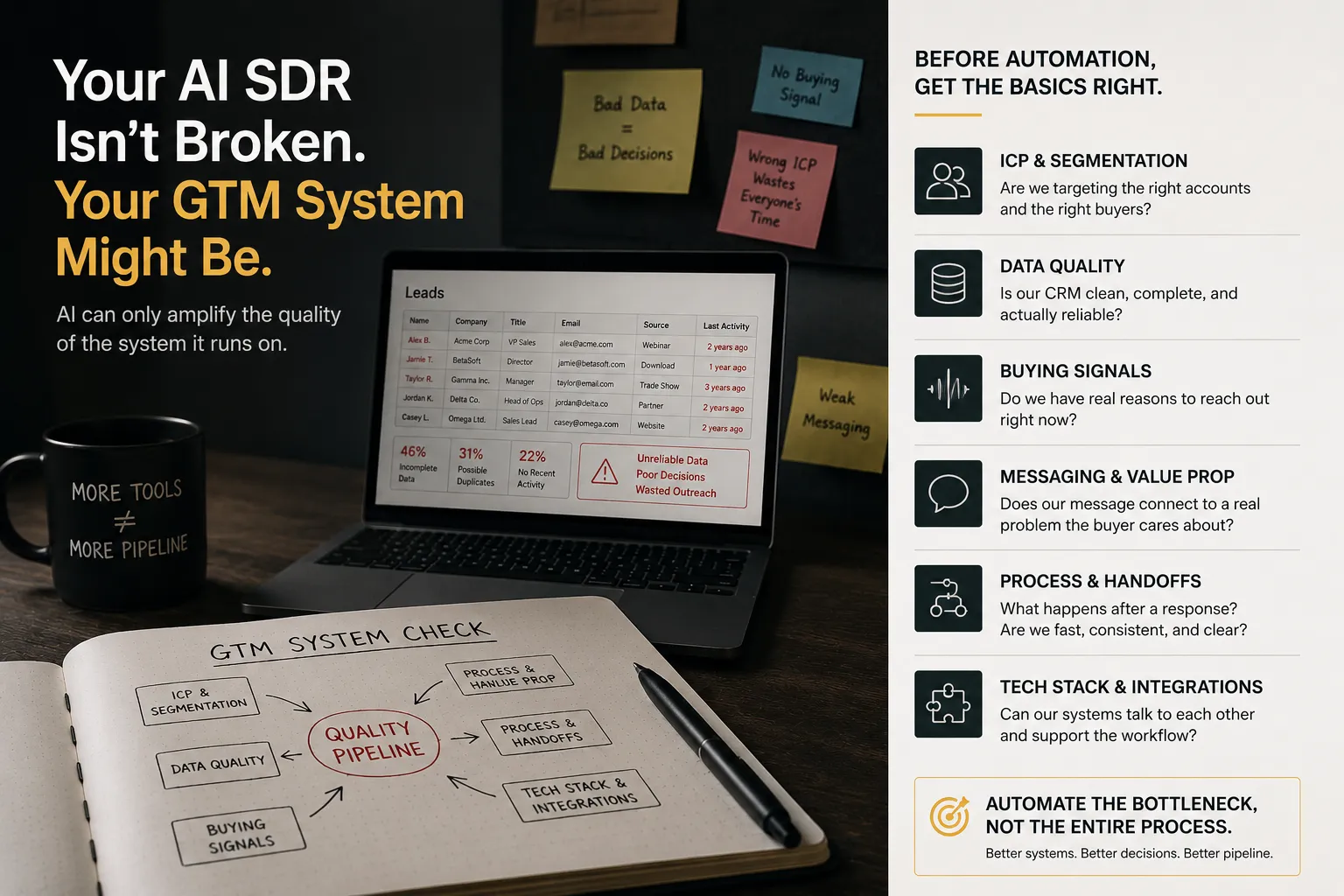
- Your AI SDR Isn’t Broken. Your GTM System Might Be. - you are here
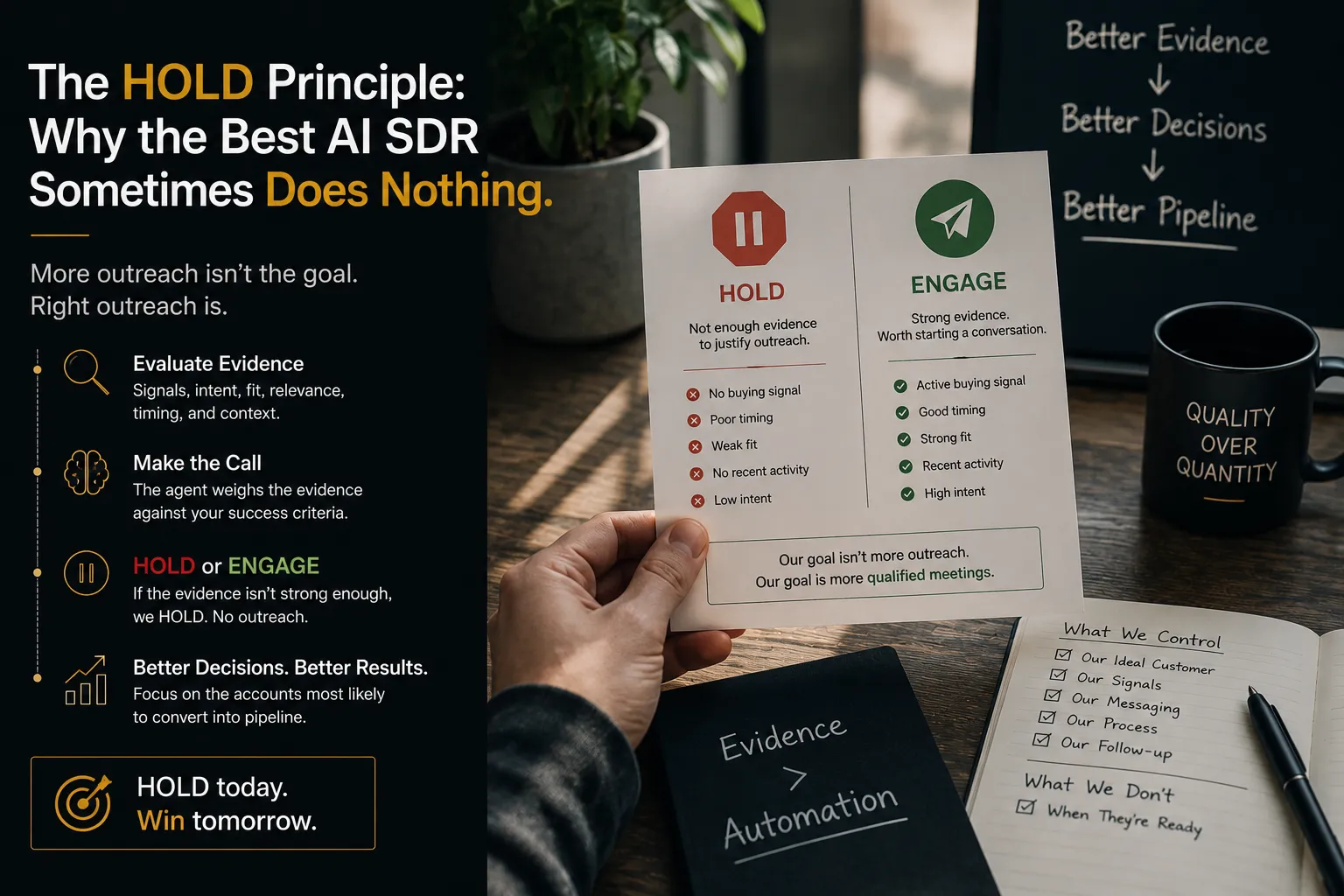
- The HOLD Principle: Why the Best AI SDR Sometimes Does Nothing
Most teams disappointed by an AI SDR conclude that the tool underperformed.
Usually the tool did exactly what it was built to do. It researched accounts, drafted messages and sent them at a volume no human could match. The problem is what it was working from.
An AI SDR inherits your ICP, your CRM data, your buying signals, your qualification rules and your messaging. It does not improve any of them. It applies them faster and more consistently than a person ever could, which is precisely what makes weak inputs expensive.
Part one argued that automating before auditing runs the wrong process faster. This part is about what the audit should actually examine.
The AI SDR is not the problem
This is where the conversation gets unnecessarily polarized.
AI SDRs are real.
They can be useful.
They can research accounts, identify prospects, enrich records, prioritize leads, generate messaging and execute parts of outbound.
HubSpot’s current AI prospecting guidance describes exactly this workflow, including lead identification, enrichment, personalization, scoring and pipeline handoff. It also recommends starting with one defined use case, maintaining CRM hygiene and measuring outcomes such as meeting conversion, lead-to-opportunity conversion and pipeline velocity.
The technology is not the enemy.
Solution-first implementation is.
There is a huge difference between:
“You need an AI SDR.”
and:
“Let’s understand your revenue motion, identify where the bottleneck is, and determine whether an AI SDR is actually the right intervention.”
The second approach may still end with an AI SDR.
It may just be a much better one.
The AI GTM agency should start with an audit
This is the principle behind Amoris.
Before building another agent, another workflow or another outbound machine, the first question should be:
Is the business actually ready for the automation it wants?
That means looking at the existing GTM system.
Not just the CRM.
Not just the prospect list.
The whole motion.
ICP
Who actually buys?
Who converts?
Which segments have evidence behind them?
Which segments only look attractive on a spreadsheet?
Data
Is the CRM trustworthy?
Are records duplicated?
Are lifecycle stages meaningful?
Is contact data current?
Can an agent actually retrieve the information it needs?
Signals
What tells us that an account is worth contacting now?
Funding?
Hiring?
Leadership changes?
Product launches?
Technology changes?
Intent?
Existing engagement?
Or are we simply calling “ICP match” a buying signal?
Messaging
Does the current proposition actually map to a problem the buyer cares about?
Is outbound failing because the copy is bad?
Or because there is no compelling reason for the prospect to respond?
Process
What happens after a lead responds?
Who qualifies it?
How quickly?
What makes a meeting qualified?
What gets written back to the CRM?
What happens when the lead is not ready?
Technology
Can the existing stack support the workflow?
Can the data be accessed?
Can systems talk to each other?
Are permissions and security handled correctly?
Can the workflow be observed when something goes wrong?
This is not bureaucracy.
This is engineering.
Why “audit first” matters even more with agents
A conventional automation can be relatively predictable.
An agent is different.
Agents reason.
They choose tools.
They make decisions.
They operate across systems.
They can encounter unexpected information.
They can propagate errors.
A recent 2026 academic review describes this emerging class of problems as agentic technical debt, including memory inconsistencies, orchestration fragility, cascading failures and unsafe autonomous decision-making.
In other words, the more autonomous the system becomes, the more important the system around it becomes.
The agent is not the whole product.
The environment the agent operates inside is the product too.
A real-world example: LangChain’s GTM agent
There is a useful example from LangChain itself.
Its GTM team found that reps were jumping between Salesforce, Gong, LinkedIn and company websites just to research a single account. The company built a GTM agent that could trigger from new leads, check whether outreach made sense, gather context and produce a reasoned draft for rep approval.
The results reported by LangChain were significant:
- 250% increase in lead-to-qualified-opportunity conversion
- 3x more pipeline dollars over the measured period
- 40 hours reclaimed per rep per month
- 1,320 hours reclaimed across the team
But look at the detail that matters.
They defined what the agent needed to do before writing the code.
The stated goals were to reduce research and drafting time and improve conversion on marketing-generated inbound.
That is the right order.
Not:
“We have agents. Where can we put them?”
But:
“Here is the revenue problem. What system would solve it?”
The difference between automation and an operating system
This distinction is becoming important.
A workflow says:
When X happens, do Y.
An AI GTM system asks:
Given everything we know about this account, what should happen next?
That requires context.
It requires data.
It requires rules.
It requires judgment.
It requires feedback.
And sometimes the correct answer is:
Do nothing.
That last part is underrated.
This is also why “lead generation” is becoming an inadequate metric
A thousand leads sound good.
Until you ask:
How many fit the ICP?
How many have a real reason to buy?
How many responded?
How many were qualified?
How many attended?
How many became opportunities?
How much pipeline did they create?
How much revenue did they produce?
The further downstream you measure, the harder it becomes to hide a broken system.
That is exactly where AI GTM needs to go.
From:
contacts generated
to:
qualified meetings created
to:
opportunities created
to:
revenue influenced
AI should make that chain more measurable, not more opaque.
Where this goes next
Once the inputs are sound, one question remains: what should the system do when the evidence does not support reaching out at all? That is part three.
Frequently Asked Questions
What is an AI SDR?
An AI SDR is an AI-powered system designed to perform some of the work traditionally handled by sales development representatives. Depending on the implementation, it can research prospects, enrich contact records, prioritize leads, generate outreach, follow up and help book meetings. AI SDRs are one possible GTM implementation, not necessarily the correct solution for every business.
Should a company implement an AI SDR before auditing its GTM?
Usually, no. The quality of an AI SDR depends heavily on the ICP, data quality, buying signals, messaging, CRM infrastructure and qualification process around it. Current sales research and GTM engineering guidance both emphasize data quality, workflow clarity and defined use cases before scaling AI prospecting.
What should an AI GTM audit examine?
A useful GTM audit should examine the ICP, lead sources, CRM data, enrichment, buying signals, qualification rules, messaging, outbound process, inbound routing, sales follow-up, technology stack, integrations, security, conversion metrics and the points where human intervention is actually required.